Bow Valley man finds a surprising harvest in garlic

HARTINGTON — Ron Hochstein knows a thing or two about taking chances.
He took a chance when he bought the Bow Valley Store and decided to keep its small-town spirit alive. And he took another chance later, listening to a piece of garden advice from his son — a suggestion that quietly turned into one of his most dependable traditions.
Hochstein spent 50 years working for the family that originally owned the property and its Sinclair station. Even after the pumps went quiet, he never really slowed down. He’s the kind of person who stays busy because he enjoys it — and because, around Bow Valley, work is just part of the rhythm of life.
A few years ago, Ron and his son, Clair, sat down with seed catalogs, planning the year’s garden. Clair had one item he was determined to add.
Garlic. Ron wasn’t convinced at first, but he finally agreed and bought a packet containing five varieties. His plan was simple: Plant them all, watch what thrives, then stick with the winner.
“I have no idea which variety it was that grew so well,” he said with a laugh.
That mystery hasn’t stopped him. Each year, he replants the best cloves from the previous season’s crop and keeps building his supply the old-fashioned way — by selecting what does well and letting it multiply.
Garlic, as it turns out, likes what Hochstein is doing. “There are two main types of garlic,” he said, “and different groups within those.”
Those types include hardneck garlic — known for bold flavor and hardy growth — and softneck varieties, which are often easier to grow and store longer. According to Nebraska Extension, some softneck types, including California Early strains, grow well in Nebraska and can store for months.
Whether Hochstein’s “winner” came from hardneck or softneck stock, what matters is this: It keeps producing.
A few years into the project, he was growing 1,000 to 1,500 plants per year.
“We always sold out,” he said. In the past three years, he’s increased that to around 2,000 plants annually — and even then, demand carries him into winter.
“I sell them until January,” he said. His system, like most good gardening routines, balances timing, observation and a little bit of faith.
He plants his garlic in early fall — once aiming for about two weeks on either side of the first day of fall, then eventually deciding to plant right on the season’s starting line.
“Whether it’s little, medium or large cloves, they all mature by July in Nebraska,” he said. “Elevation plays a part, too.”
He estimates there are about 150 varieties of garlic worldwide, each adapting to different climates and soil.
“I grow 200 to 250 pounds each year,” he said. “It can grow everywhere. But you only get back what you put into it.”
And Hochstein puts plenty into it. Crop rotation is part of his routine, along with a fertilizer plan that keeps his garden — and plenty of other projects — thriving.
“I’ve got a friend who uses dehydrated chicken manure,” he said. “He gets it by the semi-load. I usually get about 1,000 pounds.”
For a garlic patch alone, Hochstein may use 150 to 200 pounds. The rest goes into a barrel and gets used throughout the season.
“We’ll use all of it to fertilize everything,” he said. He’s also installed a simple irrigation system using lawn sprinklers — not fancy equipment, but enough to help the garden during dry spells.
“Rainwater is better than hard water,” he said. “Needless to say, our wet years are better than our dry ones.”
Even with irrigation, he’s quick to point out that garlic farming isn’t a shortcut to easy money.
“We do everything by hand,” he said. “No mechanical equipment used, other than the garden hose. It’s definitely not a get-rich-quick scheme.”
Some of his produce is sold, some shared, and some traded — the kind of quiet barter economy that still exists in rural Nebraska if you pay attention long enough.
“With onions, cucumbers, tomatoes or garlic, I take some of it up to the Senior Center in Hartington a few times a year,” he said. “I take up my vegetables and usually come back with apples.”
Other trades are even more personal. After the Bow Valley Store’s gas station shut down, Hochstein worked at Menards in Yankton for eight years. He still brings vegetables to former co-workers — and sometimes comes home with a warm meal in return.
“I come home with meatloaf, green beans, corn or roast at times,” he said. “Some of it, I just give it away.”
He said it helps his own household budget, but it also gives him satisfaction to know someone else benefits, too.
“It helps feed people who vegetables may be more of a treat than a regular staple,” he said.
Now retired, Hochstein still has no interest in sitting still.
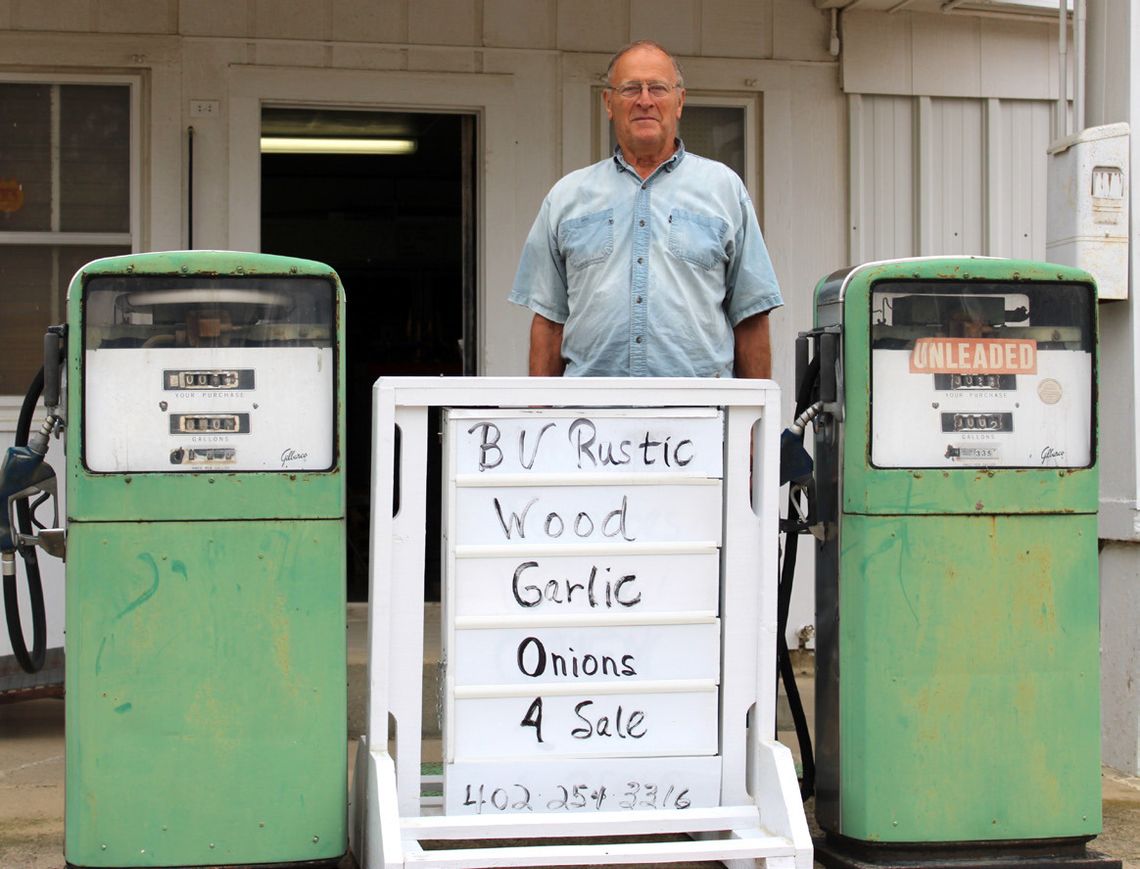
If visitors glance at the sign outside the Bow Valley Store, they’ll see the touch of his other passion: woodworking. He began adding to that part of the business in 2015, and it’s grown into a steady stream of creative projects.
“I made some blanket boxes for my grandkids,” he said. “People saw them here at the store. Suddenly, I had orders for more.”
He’s turned old countertops and local lumber into tables, end tables, live-edge shelves and balance boards — pieces that fit right in with the rustic character of the old store.
“I don’t like to sit still,” he said. The Bow Valley Rustic and Woodworking Store is located at 100 E. 899 Road in Bow Valley. The old Sinclair sign and the dinosaur are still on the property, standing guard like they always have, watching over the treasures inside.
Hochstein’s garlic harvest for this season is finished, but it will return in July — along with the onions, tomatoes and cucumbers that have become part of the store’s summertime rhythm.