Go to main contentsGo to search barGo to main menu
Friday, January 30, 2026 at 6:37 AM
Leaderboard (below main menu) securechecking
Leaderboard (below main menu) bankofhartington
No Go

Company decides not to pursue Ammonia fertilizer plant here

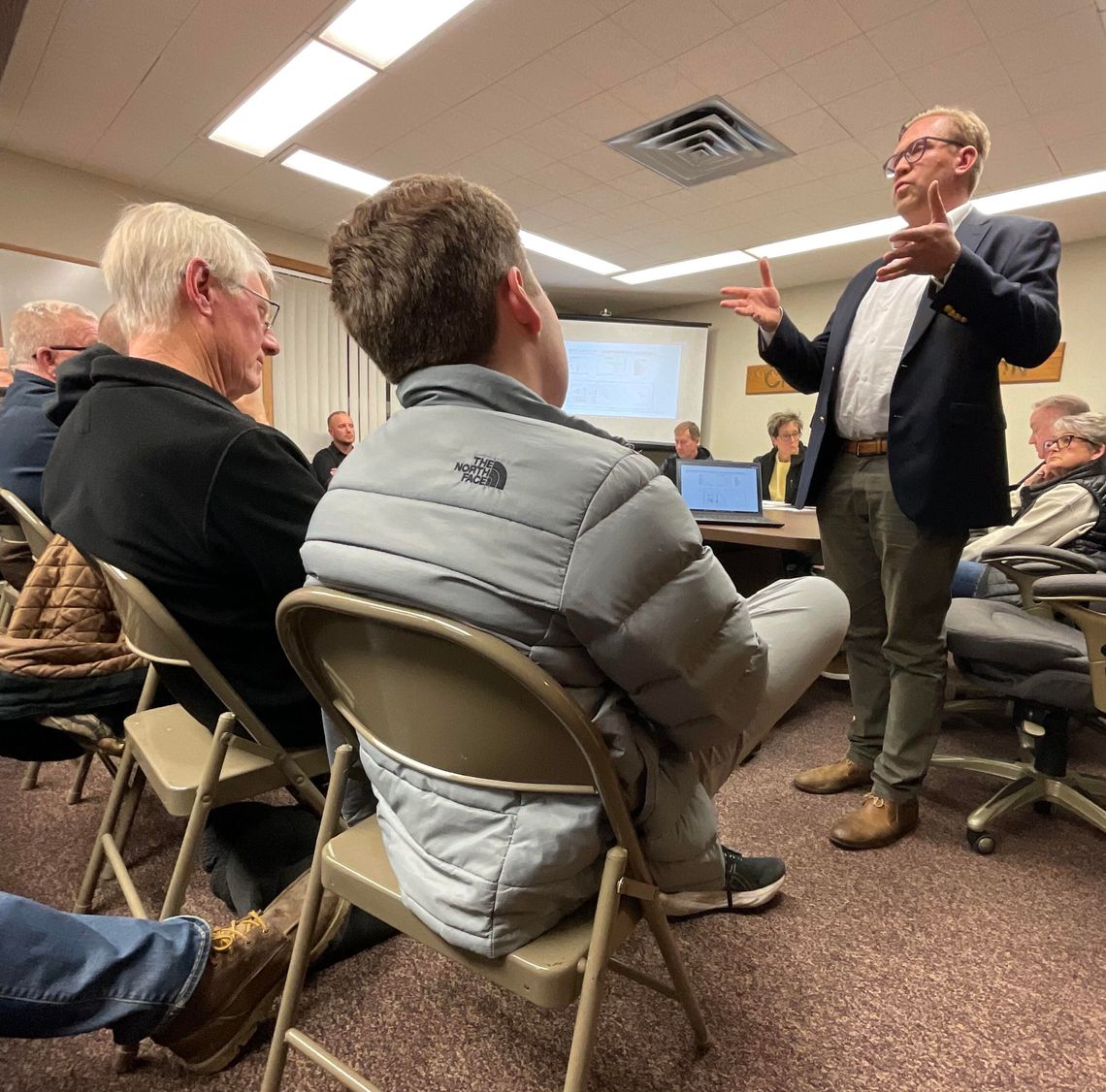
Tristan Peitz presents information about his company

HARTINGTON — A group that had planned to build an anhydrous ammonia production facility on the outskirts of Hartington has decided to withdraw its zoning application and pursue the project elsewhere.

Tristan Peitz, head of business development for TallusAg, said Tuesday the international company had decided not to move forward with its request to rezone property west of town for the proposed fertilizer production system.

TallusAg develops small-scale green ammonia production systems. Peitz said the facility would have been capable of producing up to 20 tons of ammonia per day, with an estimated annual output of 6,000 to 7,000 tons — enough fertilizer to treat 60,000 to 70,000 acres of corn.

“Our mission is to make production of this critical input (green ammonia) to agriculture cheaper, more reliable and more sustainable,” Peitz said during last week’s Hartington Planning and Zoning meeting.

Peitz said he informed Hartington Mayor Mark Becker and Cedar Knox Public Power District Manager Mike Lammers this week that TallusAg would no longer pursue the project in Hartington.

The decision followed a contentious 90-minute planning and zoning meeting last week in which company officials presented the proposal to a standing-room-only crowd of more than 70 people at Hartington City Hall.

At the conclusion of that meeting, the Hartington Planning and Zoning Board voted to table a decision on changing the zoning of a four-acre tract of land about a mile west of Hartington from agricultural to industrial, citing legal questions raised during public comment.

Peitz said the public response at the meeting made Hartington a less feasible location for the project.

“Given where things stand with the public, it creates a difficult situation for us as a company looking to develop this project,” Peitz said in a Tuesday morning interview with the Cedar County News. “It becomes a less desirable project with that sort of response.”

Peitz said TallusAg officials believed the system would have been safe and would have provided a more economical fertilizer option for area producers.

“It’s unfortunate, but we won’t be building there,” Peitz said. “There is so much misinformation, slander and fear mongering out there, it’s difficult to have a conversation with people because their minds are already made up.”

Peitz said the proposed location — a former Cedar Knox substation site — met the company’s operational needs. He also said the system was intended to be modular and containerized, rather than a traditional industrial plant. 

“It’s modular, and largely containerized. It can make up to 20 tons per day of ammonia,” Peitz said.

Peitz said the site footprint would have been less than one-half acre and would have required, at most, one truck per day.

“We specifically designed these sites for safety,” he said. “And 20 tons is the most it can produce in a day, so it’s at most one truck a day.”

Peitz said TallusAg appreciated the efforts of Cedar Knox and the city.

“From our perspective, we are really grateful for Cedar-Knox trying to make the project a success,” Peitz said. “We thank the city for considering us. They were great to work with, but unfortunately given the situation, it’s no longer a project that is worth our time.”

During the planning and zoning meeting, Peitz provided a presentation on the company’s background, the proposed system, and the process used to produce ammonia.

Most of the meeting was taken up by public questions and comments, with several residents raising concerns about safety and compatibility with existing zoning laws.

Morissa Benson was among those who spoke against the proposed project. Benson said Hartington’s zoning laws and state statutes required the city to consider public safety and welfare when reviewing rezoning requests.

“The foundational mandate of (Hartington’s) zoning ordinance states these laws exist to promote the health, safety and general welfare and to secure us from fire and other dangers,” Benson said. “A heavy industrial chemical plant induces a toxic plume risk that encompasses our schools and our neighborhoods.”

Benson also argued the proposed rezoning could be considered spot zoning.

“Selecting a single patch of agricultural land to reclassify as heavy industrial for one specific company is a textbook example of spot zoning,” she said. “This practice is highly concerning.”

Benson said Hartington’s zoning ordinance placed restrictions on emissions beyond a property’s boundaries.

“This prohibits the emission of toxic or corrosive gases, dust or odors that are detectable beyond the property line,” she said.

She also expressed concern over the facility’s location to schools and the recreation complex.

“A breach of just half day’s production puts our children directly in the toxic plume footprint,” she said.  “It is a physical impossibility for this plant to contain a leak within its property lines.”


Share
Rate

Leaderboard (footer) donmiller
Leaderboard (footer) bankofhartington
Download our app!
App Download Buttons
Google Play StoreApple App Store
Read Cedar County News e-Edition
Cedar County News
Read Laurel Advocate e-Edition
Laurel Advocate
Read The Randolph times e-Edition
The Randolph Times